IV Hydration vs. Drinking Water: What’s the Difference?
If you have ever looked at an IV hydration menu and thought, “Couldn’t I just drink a big glass of water?” you are asking the right question. For most people on most days, the answer is yes. Water works, and it should always be your first line of hydration.
IV hydration is not a replacement for drinking water. It is a different route of delivery, offered as an elective wellness service only after a provider evaluation. The real difference comes down to how fluid gets into your body and who is guiding the process.
Here is a plain-language look at both, so you can decide what actually fits your routine.
How your body hydrates when you drink water
When you drink water, it travels through your digestive system and is absorbed mostly through your intestines. From there it moves into your bloodstream and out to your cells. It is a reliable system, and for a healthy adult it does the job beautifully.
How much you need is more personal than the old “eight glasses a day” rule. The National Academies’ water intake guidance explains that needs vary, and physical activity or hot weather can increase them. That same guidance notes that food provides about 20% of the water you take in each day.
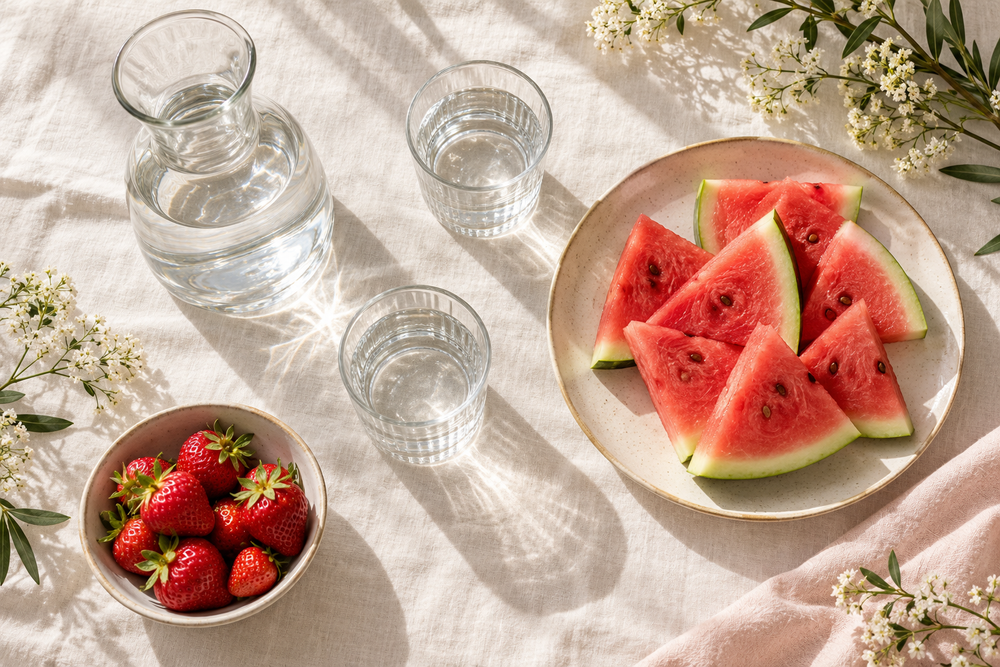 Overhead photo of a water carafe, two glasses of water, sliced watermelon, and strawberries on a linen tablecloth, illustrating that both drinks and food contribute to daily hydration.
A few things raise your needs on any given day:
- Exercise, especially when you sweat a lot
- Heat and humidity, which Central Texas knows well
- Fever, vomiting, or diarrhea
- Pregnancy and breastfeeding
For routine daily hydration, drinking water is generally all a healthy adult needs. Your body absorbs it gradually throughout the day, and that steady approach works well. Questions about IV hydration usually come from curiosity about how the two compare.
What IV hydration does differently
IV hydration delivers fluids, and sometimes selected nutrients, directly into a vein through a small catheter. This describes the route of administration: the fluid enters your bloodstream without passing through your digestive system. A different route does not automatically mean better results for a healthy adult.
In hospitals, IV fluids are a medical treatment. Cleveland Clinic explains that IV fluids are specially formulated liquids used to prevent or treat dehydration and electrolyte imbalances. Hospital uses include caring for people who are sick with vomiting or diarrhea, seriously injured, or having surgery. That clinical care is a different situation from elective wellness IV hydration. The fact that hospitals use IV fluids does not mean a wellness IV is necessary, or better than drinking water, for a healthy adult.
Elective wellness IV hydration is an optional service, not a medical necessity. It takes place in a calm suite, where a licensed provider first evaluates whether it is appropriate for you and, if so, which formulation fits.
Here is how the two compare at a glance:
| At a glance | Drinking water | IV hydration |
|---|---|---|
| How fluid enters | Through your digestive system | Directly into a vein |
| Purpose | Routine daily hydration | Elective wellness service |
| Who guides it | You | A licensed nurse or provider |
| Cost | Practically free | A paid wellness service |
| When it fits | Generally sufficient for routine daily hydration | Only after an individual provider evaluation |
| Time | Sips throughout the day | Generally 30 to 90 minutes |
One honest note: how each person responds varies. IV hydration is not automatically faster, better, or more effective than drinking water, and drinking water is generally sufficient for routine daily hydration. It is not a cure for anything, and it does not replace the basics.
Why people ask about IV hydration
Nobody needs an IV to get through a normal Tuesday. Still, people ask us about it for all kinds of reasons. These are some of the questions we hear:
- After heavy sweating. Someone finishes a long workout or an afternoon in the Texas heat and wonders whether an IV would help.
- During a busy stretch. Someone realizes they have forgotten their water bottle for days and asks whether an IV makes sense.
- Around travel. Someone has flights or long drives coming up and is curious about their options.
- Wanting a reset. Someone likes the idea of quiet time for their wellness and asks about an IV.
These are reasons people ask, not proof that IV hydration is right for them. Whether it is appropriate depends on an individual evaluation by a qualified provider. In most of these situations, drinking water, eating well, and resting are the place to start.
If you are curious about other options, wellness injections are another service some clients pair with their routine. They are quick to administer and are also personalized to your goals and your provider’s recommendations.
When a glass of water is enough
Most of the time, it is. If you feel a little thirsty, your energy dips mid-afternoon, or you realize you skipped water all morning, start with your water bottle. Add a snack with water-rich foods like melon or strawberries.
Some simple habits help more than people expect:
- Keep a refillable bottle where you can see it.
- Drink a glass with each meal.
- Drink before, during, and after exercise.
- Check your urine color. Pale yellow is a good sign.
There is also a line where neither water at home nor a wellness IV is the right call. Mayo Clinic’s overview of dehydration advises seeing a doctor for diarrhea lasting 24 hours or more, confusion or unusual sleepiness, or not being able to keep fluids down. Bloody or black stools are another reason to get medical care.
If any of that sounds like you, please contact your healthcare provider or seek urgent care. A wellness suite is not the place for a medical emergency, and we would always rather you get the right care first.
What to expect at an IV hydration appointment at Luxe
If you decide IV hydration is worth exploring, it helps to know what the visit actually looks like. At Luxe League Wellness in Pflugerville, the process is simple and unhurried.
 Warm interior view of the Luxe League Wellness suite featuring black IV lounge chairs, a white treatment chair, an IV stand, soft floral details, and warm neutral finishes.
It starts with a conversation. Before anything else, your practitioner talks with you about your wellness goals and whether IV hydration is appropriate for you. This is your time to ask questions. Whether it is the right fit is part of that conversation too.
Your formulation is chosen for you. There is no one-size-fits-all drip. Your practitioner recommends fluids and nutrients based on your goals and eligibility.
Then you relax. A session generally takes 30 to 90 minutes, depending on your treatment plan. Bring a book, catch up on messages, or simply rest.
Afterward, follow your provider’s instructions. Your healthcare professional will tell you what applies to you after your session, and their instructions come first.
You can read more about the service on our IV hydration page. It is also part of our broader wellness menu, which brings provider-guided options together in one place.
Luxe League Wellness was co-founded by two nurses, Stephanie Moreno, NP, and Brittney Maxwell, LVN. You can learn more about them on our About page. Care in our suite is personal, and that starts with the people providing it.
Frequently asked questions
Is IV hydration better than drinking water?
Not better, just different. For routine daily hydration, drinking water is generally sufficient. IV hydration delivers fluid directly into a vein, which is a different route of administration, not an automatically better one.
How long does an IV hydration session take?
A session generally takes 30 to 90 minutes. The exact time depends on the fluids and nutrients in your treatment plan.
How often can you get IV hydration?
It depends on the person. Your practitioner sets a schedule based on your goals and needs during your consultation.
Are there side effects?
Yes, IV therapy has potential risks. Those risks can depend on your health history and on the ingredients used in a specific treatment. A qualified healthcare provider should explain the complete risks to you before any treatment, and you should feel free to ask as many questions as you need.
Do I still need to drink water if I get IV hydration?
Yes. IV hydration is a support for occasional moments. Daily water intake and a balanced diet still matter most.
Who should talk to a doctor first?
This article cannot determine whether IV hydration is appropriate for you. Eligibility has to be assessed individually by a qualified healthcare provider who reviews your health history and goals. If you have questions about your own situation, bring them to your healthcare provider or to your consultation.
The bottom line
Water is your everyday hydration plan, and nothing replaces it. IV hydration is an elective, provider-guided service, and whether it fits you depends on an individual evaluation of your goals and health history.
If you are still deciding, that is completely fine. Bookmark this article for later, or send it to the friend who always asks whether IVs are worth it.